Sunday, 26 August 2012
6s and 7s #1

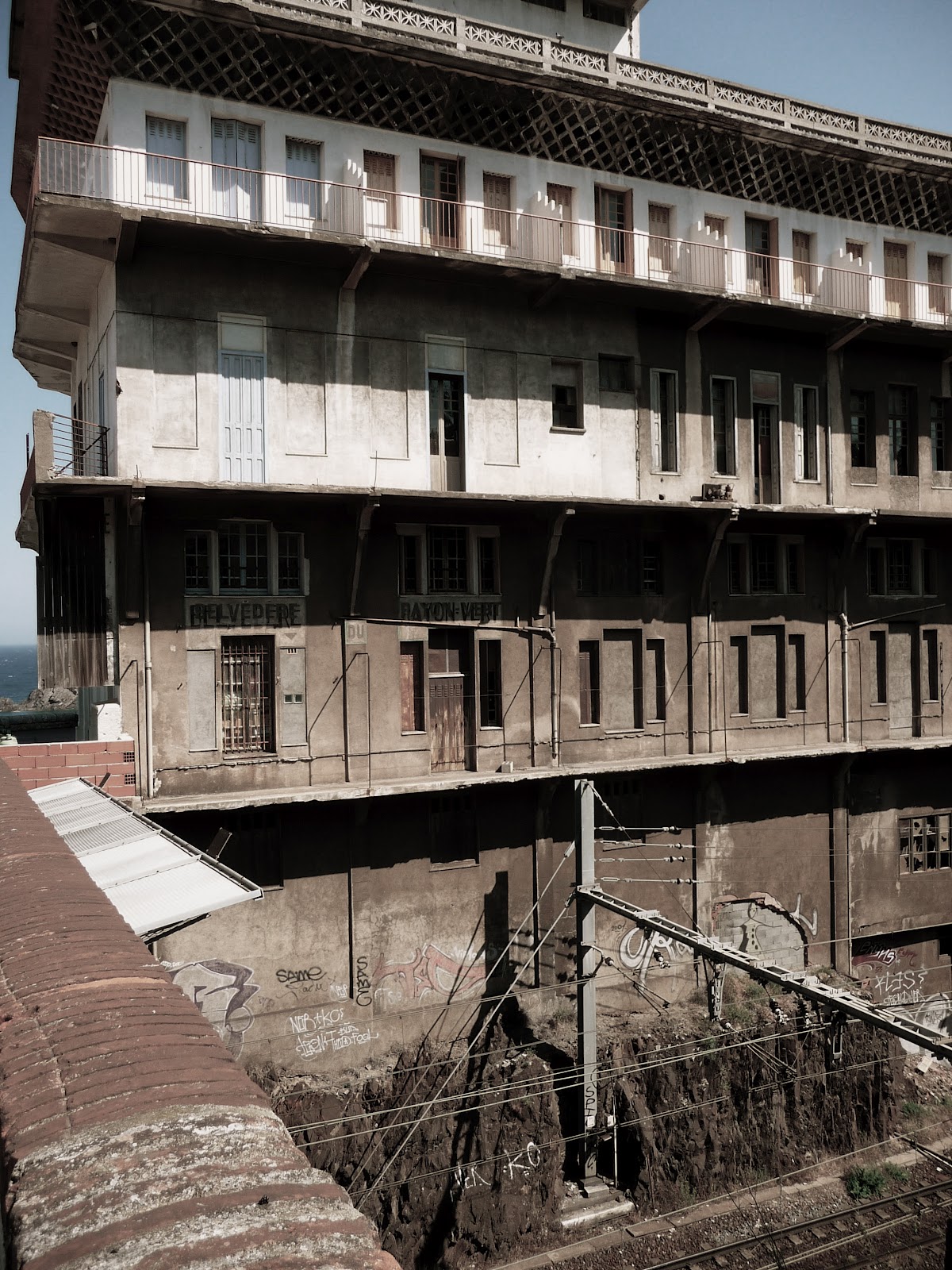
Cerbère 21:8:2012
Cerbère 21:8:2012
An assemblage of found sounds - disused metal pipes in an old tunnel underneath Cerbère railway station, Ezra singing a note to try out the strange resonance, plus aforementioned driftwood balafon.
An assemblage of found sounds - disused metal pipes in an old tunnel underneath Cerbère railway station, Ezra singing a note to try out the strange resonance, plus aforementioned driftwood balafon.
Wednesday, 22 August 2012
more strange sights and sounds from Cerbère
Chance encounter with two members of rare coastal-dwelling Mediterranean tribe who play their strange music on crudely-made driftwood balafons....
Cerbère, un peu plus tard....
A bit later that evening after the pause - three dances in each half...In this selection, having heard the tune just a couple of times, the dancers are getting into their stride. They seem to have sussed where the music is going, and it's not that straightforward. There's a formula for beginning and ending and a 'surprise' 2-bar break for the flagiolist thrown in somewhere, an asymmetrical framework of sections called curts (short steps) and llargs (long steps)
Cercle Cerbère
Just returned from a couple of days on the Côte Vermeille, in this last town before Spain - a constant source of wonderment and inspiration. Big SNCF depot with all kinds of scraping, hissing, squealing and clanging, plus the sounds of nature, cicadas, sea, chickens....
This visit we found to some real folklore. The shady 'place de village' was, we were told, made in a circular shape to accommodate the evenings of Sardanas (no, not sardines, must turn off this predictive text) - traditional Catalan circle dances which old and young alike join in, though being French as well as Catalan there is probably a slight reluctance on the part of the male population to dance with such dainty steps. The circles should be boy-girl-boy-girl but the boys here were rather outnumbered. The 11-piece band cobla have some very distinctive Catalan instruments - 2 tible and 2 tenore - raucous oboe/shawm-type instruments and the leader who plays 2 instruments simultaneously - a flabiol - small flute - and a tambori - a tiny drum strapped to his arm.
When the band start up each number it takes a while for the dancers to take to the floor. This is because they're busy figuring out what the musicians are up to, the structure, the time divisions, etc which dictate what dance steps are appropriate. As soon as they have it sussed they begin to form little circles which then grow in size. Camera had a bit of difficulty focussing in the low light....
This visit we found to some real folklore. The shady 'place de village' was, we were told, made in a circular shape to accommodate the evenings of Sardanas (no, not sardines, must turn off this predictive text) - traditional Catalan circle dances which old and young alike join in, though being French as well as Catalan there is probably a slight reluctance on the part of the male population to dance with such dainty steps. The circles should be boy-girl-boy-girl but the boys here were rather outnumbered. The 11-piece band cobla have some very distinctive Catalan instruments - 2 tible and 2 tenore - raucous oboe/shawm-type instruments and the leader who plays 2 instruments simultaneously - a flabiol - small flute - and a tambori - a tiny drum strapped to his arm.
When the band start up each number it takes a while for the dancers to take to the floor. This is because they're busy figuring out what the musicians are up to, the structure, the time divisions, etc which dictate what dance steps are appropriate. As soon as they have it sussed they begin to form little circles which then grow in size. Camera had a bit of difficulty focussing in the low light....
Thursday, 2 August 2012
Not La Java Javanaise
I don't know if Boris Vian or Serge Gainsbourg ever played the gamelan, or where indeed this peculiar way of speaking came from. Just returned from the Saint-Lizier Festival teaching Javanese music to a group of extremely talented young musicians. They were there to perfect their virtuoso piano-playing and vocal skills, but all took part in the gamelan group every morning. Being the 150th anniversary of Debussy's birth it was the idea of festival director David Lively to show some of the influences on his music, and the encounter with Javanese gamelan music at the Great Exhibition of 1889, according to many musicologists, was a decisive one - the multi-layered floating textures, rootless whole-tone scales, sonorous gongs in the bass, rippling pentatonic patterns, may never have happened otherwise.
First excerpt is part of an exit piece or bubaran - the Hudjan rain Mas gold of the title is to wish everyone 'much wealth' as they leave, and is therefore, understandably, a firm favourite with Javanese audiences.
The other, entitled Ladrang Mugirahayu features the great American soprano June Anderson together with her student Nana Sawaushi.
Many thanks to all the students and teachers, to David, Gilles super-administrator person, for such a great week, and the technicians who moved the gamelan around with such good humour.
"><iframe width="420" height="315" src="http://www.youtube.com/embed/udL46cKJOuU" frameborder="0" allowfullscreen></iframe>
First excerpt is part of an exit piece or bubaran - the Hudjan rain Mas gold of the title is to wish everyone 'much wealth' as they leave, and is therefore, understandably, a firm favourite with Javanese audiences.
The other, entitled Ladrang Mugirahayu features the great American soprano June Anderson together with her student Nana Sawaushi.
Many thanks to all the students and teachers, to David, Gilles super-administrator person, for such a great week, and the technicians who moved the gamelan around with such good humour.
"><iframe width="420" height="315" src="http://www.youtube.com/embed/udL46cKJOuU" frameborder="0" allowfullscreen></iframe>
Subscribe to:
Posts (Atom)